Towards Digital Inclusion: A Review of Mobile User Interfaces for Older Adults
A systematic literature review exploring how mobile interfaces can better support older adults through accessible, intuitive, and human-centered design.
Overview
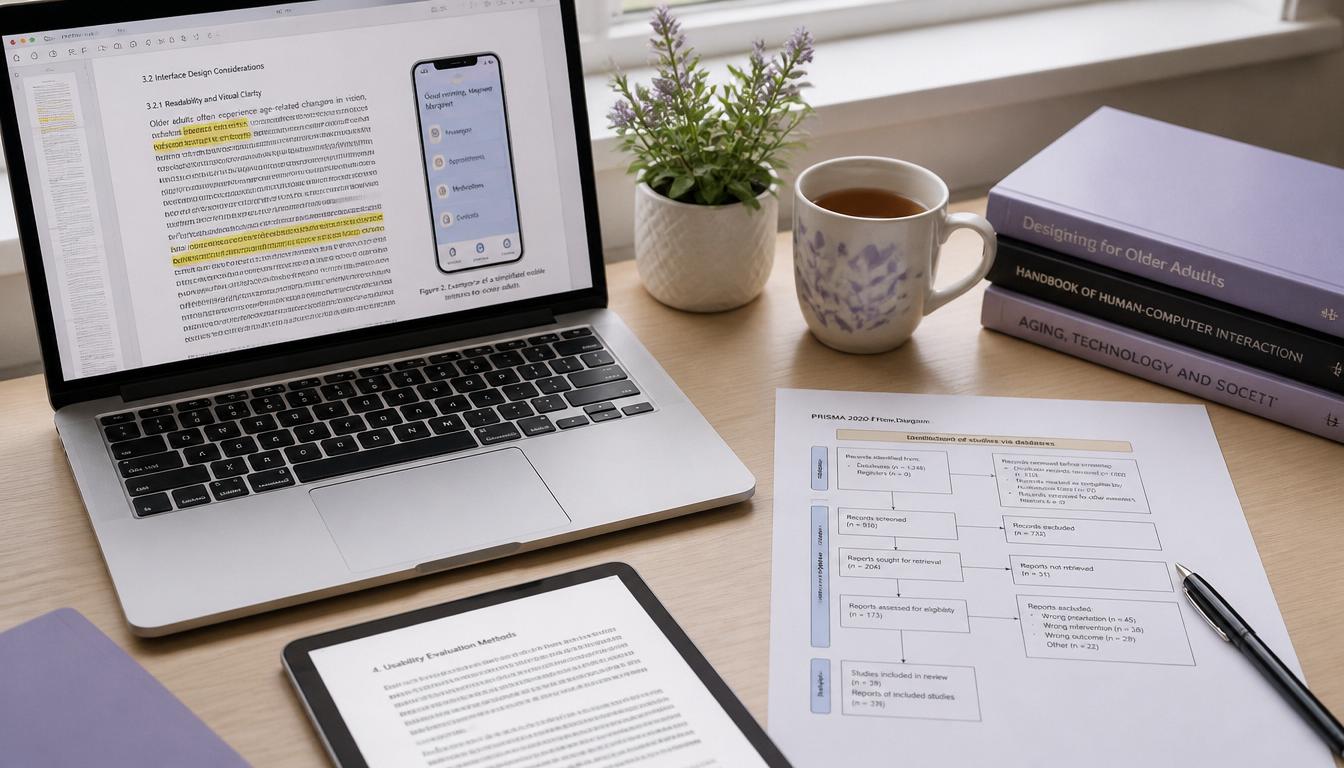
This project investigates how mobile user interfaces can better support older adults, a demographic that is often overlooked in digital product design. Using the PRISMA methodology and thematic analysis, I reviewed existing HCI research to identify common usability challenges, successful design patterns, and opportunities for creating more accessible and inclusive mobile experiences.
Process
- 1Defined research questions around digital inclusion and older adults.
- 2Conducted a systematic literature search across ACM Digital Library and IEEE Xplore using the PRISMA methodology.
- 3Screened nearly 500 publications based on predefined inclusion and exclusion criteria.
- 4Performed a thematic analysis to identify recurring usability strengths, weaknesses, and design recommendations.
- 5Synthesized the findings into actionable insights for future mobile interface design.
Key insights
- Older adults struggle with small interface elements, unclear navigation, and low discoverability.
- Voice interfaces and natural language interaction show strong potential for improving accessibility.
- Familiar interaction patterns and clear visual hierarchy reduce cognitive load.
- Features that increase users' confidence—such as trial modes or protected settings—can improve digital inclusion.
- Accessibility should be considered an integral part of good interaction design rather than a special feature.
Outcome
The project resulted in a systematic review that consolidated current research into practical design recommendations for mobile interfaces aimed at older adults. Beyond identifying usability challenges, the review highlighted the growing potential of conversational interfaces and voice interaction as tools for improving digital inclusion.
Reflection
This project marked the beginning of my interest in designing technology for older adults and ultimately inspired the direction of my master's thesis. Through reviewing existing HCI research, I realized that many older adults remain digitally excluded despite rapid technological progress. I wanted to move beyond studying the problem and start designing solutions. That motivation led me to pursue my master's thesis, where I now conduct user research and prototype wearable technology together with older adults to better understand their needs and create more inclusive products.